Novel Relics
The Complete Sportsman c.1760 & Walton's Complete Angler 1826 — Two Books from the Gresley Collection | Signed Charles Gresley | Antiquarian Field Sports
The Complete Sportsman c.1760 & Walton's Complete Angler 1826 — Two Books from the Gresley Collection | Signed Charles Gresley | Antiquarian Field Sports
Or spread the cost with Klarna — pay in 3 interest-free instalments of £70.0.
No hidden fees when you pay on time.
Available at checkout — subject to status. Learn more
Couldn't load pickup availability
Two books, one hand, one shelf.
These arrived together and we've kept them together, because they belong together. Both carry the same signature on the front endpaper — Charles Gresley, written with the same flourish and the same looping underline beneath it, unmistakably the same man on the same afternoon with the same pen. And both are about the same thing: getting out of the house.
One teaches you to chase things across a field. The other teaches you to stand very still in a river. Between them they cover the whole range of what an English gentleman did with his time when he wasn't obliged to do anything at all.
The Complete Sportsman; or, Country Gentleman's Recreation
Thomas Fairfax, Esq. — London: printed for J. Cooke at Shakespear's-Head, Pater-noster-Row. Undated, c.1760s.
This is the Georgian country gentleman's handbook to absolutely everything, and it does not know the meaning of restraint. Hare-hunting, fox-hunting, buck-hunting and otter-hunting. The rearing and backing of colts. The management of race-horses. Coursing, bowling, and angling in all its various branches. The breeding of pigeons, rabbits and canary birds. Finding the haunts of partridges and pheasants. Shooting — and shooting flying, which was still a novelty worth writing about. There is a great deal on game cocks and how to fight them, which is a window onto eighteenth-century leisure that we'd rather leave open than paint over.
The engraved frontispiece is the best thing in it: an entire hunt in full cry, riders, hounds pouring across the middle distance, and one solitary angler standing in the water paying no attention to any of them. Beneath it a couplet that tells you exactly what the book thinks of itself — A Chace is Sure superior to all Wealth; It gives us Pleasure, and it gives us Health.
One thing we should clear up, because plenty of sellers don't. This is not Sir Thomas Fairfax the Civil War general. He died in 1671, which puts him roughly ninety years short. "Thomas Fairfax, Esq." was a name the trade stuck on the title page to shift copies, and it worked — the book went through edition after edition, many of them undated and all of them cheerfully confusing to bibliographers ever since.
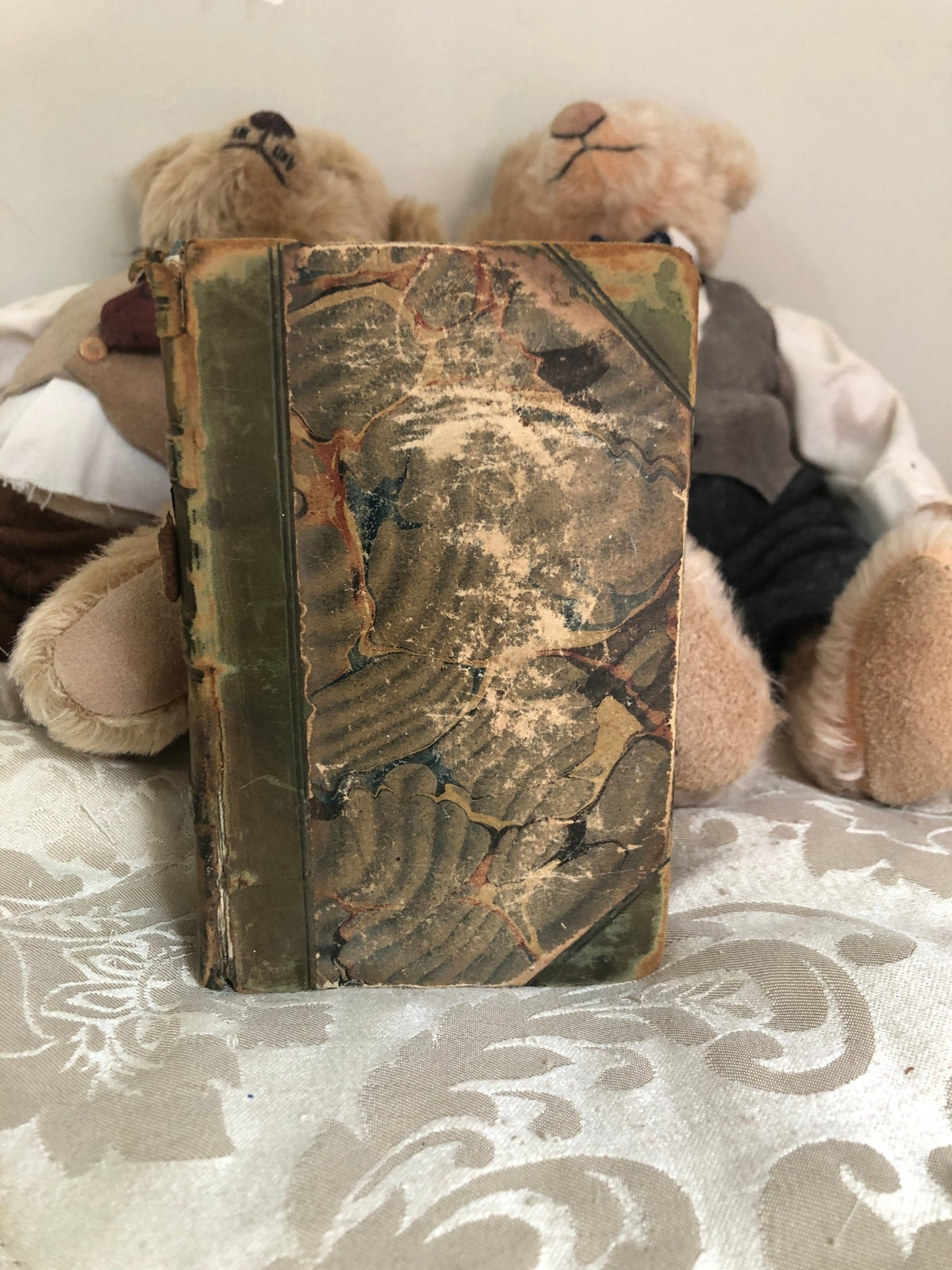
Rebound in the nineteenth century in half green calf over marbled boards, spine ruled in gilt with a red morocco label. Inside the front board, still bright, is the trade ticket of B. Hunt & Sons of High Street, Birmingham — engravers, copper plate printers and bookbinders. Somebody in the Midlands cared enough about this book to have it properly dressed.
The Complete Angler of Izaak Walton and Charles Cotton — Volume I
Chiswick: printed by C. and C. Whittingham, sold by Thomas Tegg of Cheapside and others. 1826.
The loveliest book ever written about doing very little. First published in 1653 and never out of print since, The Complete Angler is only nominally about fishing. It is really about friendship, birdsong, country inns, milkmaids who sing, and the specific and irreplaceable happiness of a day spent nowhere important. Here it is in the handsome little Whittingham printing of Sir John Hawkins's text, issued for Thomas Tegg's Cabinet Library, with an engraved portrait of Walton at the front and a vignette title showing a creel and rod abandoned under the trees, which is the whole book in one picture.
This is Volume I of two, and Volume II is not present. We'd rather tell you that in bold than let you find it out at the bottom of the page.
And then there's the thing pasted inside the front board, which is our favourite detail in either book. It is a Punch cartoon captioned "Walton's Complete Bungler" — a fisherman in a flat cap, line hopelessly wrapped round the branches above him, face a picture of pure despair, over the caption "Confound it! — and the fish rising so nicely!" Somebody cut that out and stuck it in the front of their Walton on purpose. We choose to believe it was Mr Gresley, and that he knew exactly what he was admitting.
Bound in contemporary half calf over marbled boards with marbled edges, gilt-ruled spine, red morocco label. (A small point that catches people out: the preliminaries include an "Advertisement to the Edition Published by Sir John Hawkins, 1760." That's reprinted editorial matter, not a date. The book is 1826.)
A word about the Gresleys
The name in the front of these books belongs to one of the oldest families in England — and one of the more quietly extraordinary.
The Gresleys were Norman. Domesday recorded Nigel de Stafford holding the manor of Drakelowe in Derbyshire towards the close of the eleventh century, and his descendants held it for nine hundred years — as long as any family in England is said to have owned the same patch of ground. They took their surname from Castle Gresley, founded a priory nearby before the year 1200, and in 1611 were granted a baronetcy that was the sixth oldest in the whole of Britain.
They were not, however, a family much given to caution. Sir Nigel Gresley, the sixth baronet, went to sea with the Royal Navy at a tender age, made lieutenant, was invalided out with rheumatism, inherited Drakelow and Knypersley, discovered he was sitting on coal, and in 1775 got an Act of Parliament through to dig his own canal — which then held a monopoly on Newcastle-under-Lyme coal for forty-two years. His kinsman Sir Roger, the eighth baronet, went the other way entirely: Christ Church, Oxford without troubling to take a degree, a celebrated London dandy, a seat in Parliament, and a gambling habit that ate most of the family fortune and obliged him to sell nearly everything to stay solvent. He died at thirty-seven, and his library went under the hammer the following spring.
The family motto, chosen long before either of them, is Meliore fide quam fortuna — better in faith than in fortune. One suspects it was tested.
Our Charles belonged to the Lichfield branch — we know from the armorial bookplate in another book from this same library, which names him Charles Gresley, Esquire, of Lichfield. Richard Gresley of Stowe House, Lichfield, a descendant of the Drakelow Gresleys and a bencher of the Middle Temple, headed that line, and his eldest son William became a prebendary of Lichfield Cathedral in 1840. There is a memorial to a Charles Gresley in the cathedral itself.
There is one more Gresley you will certainly have heard of, even if the name means nothing to you. A younger branch had settled at Netherseal, where four successive Gresleys served as rector of St Peter's; the last of them, the Reverend Nigel Gresley, had a fourth son born in 1876. That son was Sir Herbert Nigel Gresley, Chief Mechanical Engineer of the LNER, who designed the Flying Scotsman and the Mallard — which in 1938 hit 126 miles per hour and still holds the world record for a steam locomotive. The family that turned up in Domesday with a plough ended up with the fastest thing on rails.
The last Gresley left Drakelowe Hall in 1931, after twenty-eight generations. The house was pulled down three years later and a power station built on the site. The books, evidently, got out.
Provenance. From the library of Charles Gresley, Esquire, of Lichfield, of the Lichfield branch of the Gresleys of Drakelowe, whose signature appears on the front endpaper of both volumes and whose armorial bookplate appears in another book from the same group. Acquired by us at auction.
Condition, told straight
Neither of these is a fine copy and we won't dress them up as one.
The Fairfax has a rubbed spine with real surface loss, a chipped label, a cracked front joint and a hinge that's started to go internally. The boards are on and it handles perfectly well, but it wants a gentle hand. Corners worn through. Pages toned with scattered foxing throughout, which is simply what paper of this age does. Frontispiece and title both present and clear.
The Walton is rougher. The head of the spine is chipped away with the blue headband showing through, the front joint is cracked, the corners are worn and the label is defective. The text block is sound and the leaves are clean enough. Frontispiece and vignette title both present.
So — reading copies and shelf copies, not investment pieces. But between them they've got the better part of four hundred and fifty years on the clock, they've survived a good deal more than most objects manage, and standing side by side they look magnificent.
One last thing. Pencilled in the back of each are prices from booksellers long gone: £2.50 and £1.50. Somebody, once, got an absolute steal.
Sold as a pair. Part of the Gresley Collection. One of a kind — when they're gone, they're gone.
Free UK delivery. Hand-wrapped by us in stiff card and packing paper.
Share