Novel Relics
The Noble and Gentle Men of England — Evelyn Philip Shirley | 1859 First Edition | Charles Gresley of Lichfield's Copy | Armorial Bookplate
The Noble and Gentle Men of England — Evelyn Philip Shirley | 1859 First Edition | Charles Gresley of Lichfield's Copy | Armorial Bookplate
Or spread the cost with Klarna — pay in 3 interest-free instalments of £75.0.
No hidden fees when you pay on time.
Available at checkout — subject to status. Learn more
Couldn't load pickup availability
A gentleman of an ancient house, looking up his own family.
In 1859 Evelyn Philip Shirley published his attempt to set down, county by county, the arms and descents of every ancient knightly and gentle house still surviving in England — those established before the sixteenth century, traced in the male line, still holding their ground. It was a serious piece of Victorian antiquarian labour and it remains a standard reference.
This copy belonged to Charles Gresley, Esquire, of Lichfield. We know because his armorial bookplate is pasted inside the front board, encircled with the words Liber Caroli Gresley Armigeri de Lichfield A.D. 1854 — the book of Charles Gresley, Esquire, of Lichfield.
Which means that when this book arrived, he could turn to the Derbyshire pages and find his own family waiting for him.
The Shirley connection. Pasted beneath the bookplate, in Gresley's hand, is the single word From — and below it a cut fragment of a letter in Shirley's own writing, ending my dear sir, very sincerely yours, with his full signature. Gresley kept the proof of who gave him the book and stuck it in the front. We should be precise: this is a pasted letter fragment, not an inscription written into the volume. What it strongly suggests is a gift from one antiquary to another; what it certainly is, is Shirley's autograph, preserved on purpose.
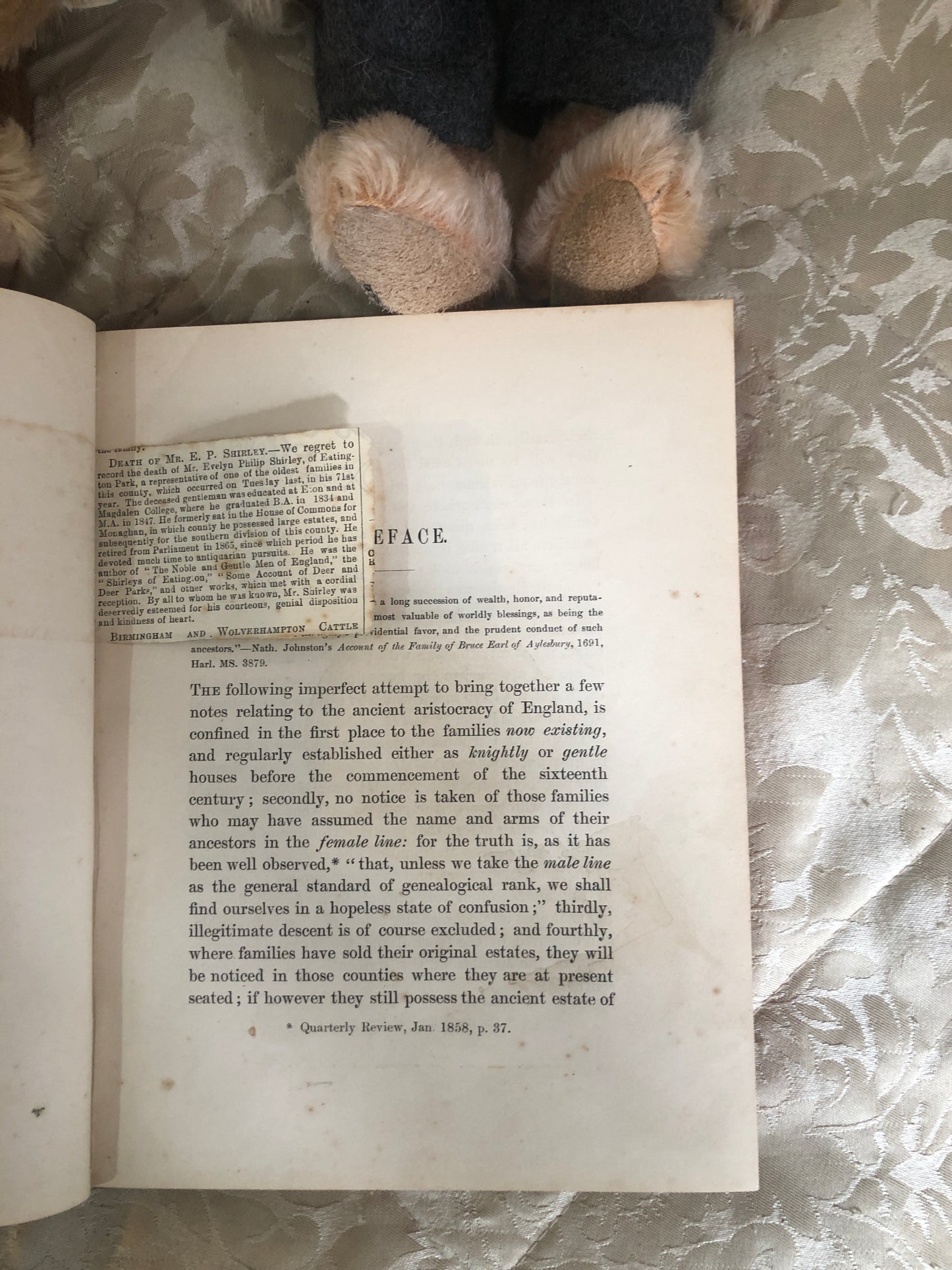
Tipped in at the preface is a newspaper cutting reporting Shirley's death — of Eatington Park, in his seventy-first year, sometime Member for Monaghan and afterwards for the southern division of Warwickshire, retired from the Commons in 1865, author of this book and of The Shirleys of Eatington. A further folded cutting about the Baronetage sits loose, pencil-dated 1898. Both postdate Shirley's death in 1882, so either Gresley lived on and kept feeding his book, or a later owner carried on the habit. We can't tell you which, but somebody cared about this volume for a very long time.
A word about the Gresleys
The name on the bookplate belongs to one of the oldest families in England — and one of the more quietly extraordinary.
The Gresleys were Norman. Domesday recorded Nigel de Stafford holding the manor of Drakelowe in Derbyshire towards the close of the eleventh century, and his descendants held it for nine hundred years — as long as any family in England is said to have owned the same patch of ground. They took their surname from Castle Gresley, founded a priory nearby before the year 1200, and in 1611 were granted a baronetcy that was the sixth oldest in the whole of Britain.They were not, however, a family much given to caution. Sir Nigel Gresley, the sixth baronet, went to sea with the Royal Navy at a tender age, made lieutenant, was invalided out with rheumatism, inherited Drakelow and Knypersley, discovered he was sitting on coal, and in 1775 got an Act of Parliament through to dig his own canal — which then held a monopoly on Newcastle-under-Lyme coal for forty-two years. His kinsman Sir Roger, the eighth baronet, went the other way entirely: Christ Church, Oxford without troubling to take a degree, a celebrated London dandy, a seat in Parliament, and a gambling habit that ate most of the family fortune and obliged him to sell nearly everything to stay solvent. He died at thirty-seven, and his library went under the hammer the following spring.
The family motto, chosen long before either of them, is Meliore fide quam fortuna — better in faith than in fortune. One suspects it was tested.Our Charles belonged to the Lichfield branch. Richard Gresley of Stowe House, Lichfield, a descendant of the Drakelow Gresleys and a bencher of the Middle Temple, headed that line, and his eldest son William became a prebendary of Lichfield Cathedral in 1840. There is a memorial to a Charles Gresley in the cathedral itself.
There is one more Gresley you will certainly have heard of, even if the name means nothing to you. A younger branch had settled at Netherseal, where four successive Gresleys served as rector of St Peter's; the last of them, the Reverend Nigel Gresley, had a fourth son born in 1876. That son was Sir Herbert Nigel Gresley, Chief Mechanical Engineer of the LNER, who designed the Flying Scotsman and the Mallard — which in 1938 hit 126 miles per hour and still holds the world record for a steam locomotive. The family that turned up in Domesday with a plough ended up with the fastest thing on rails.
The last Gresley left Drakelowe Hall in 1931, after twenty-eight generations. The house was pulled down three years later and a power station built on the site. The books, evidently, got out.
Provenance. From the library of Charles Gresley, Esquire, of Lichfield, of the Lichfield branch of the Gresleys of Drakelowe, whose armorial bookplate — Liber Caroli Gresley Armigeri de Lichfield A.D. 1854 — identifies him beyond doubt. Acquired by us at auction as part of a small group of books from that library, each carrying his name.
Condition. Handsomely bound in full maroon leather, lettered in gilt direct to both spine and front board, with gilt ornaments in the compartments and raised bands. Rubbing to the spine ends and board edges, corners lightly worn, a few marks to the covers. Internally toned with scattered foxing and some tide-marking, heavier around the tipped-in material. Square, tight and entirely sound — much the best preserved book we have handled from this library.
Part of the Gresley Collection. One of a kind — when it's gone, it's gone.
Free UK delivery. Hand-wrapped in stiff card and packing paper.
Share